
Why You Shouldn't Skip a Lawn Care Treatment
Call Us Now at 512-861-7802.

Looking for Professional Lawn Care?
We proudly serve the Austin and San Antonio metro areas with reliable, professional lawn care.
You tell yourself it's just one treatment. The lawn looks fine. Life got busy. You'll catch up next round.
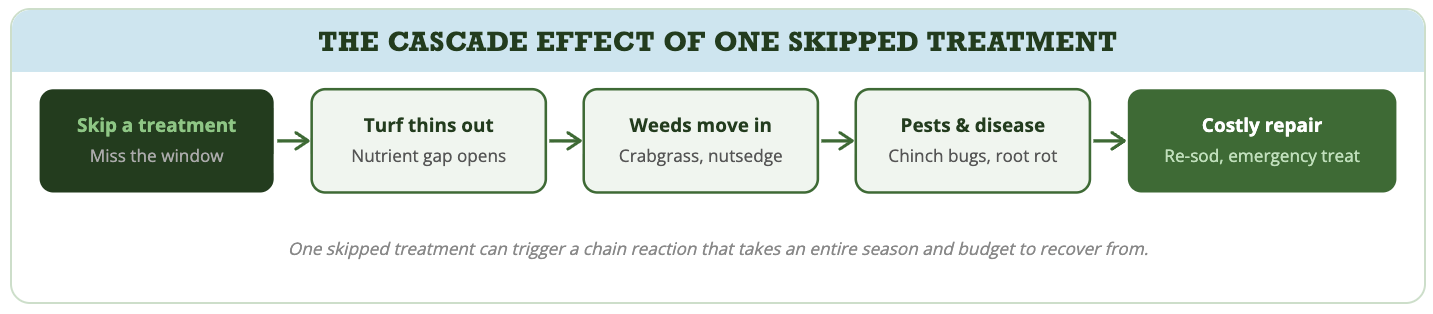
Six weeks later, crabgrass is spreading across the front yard. There's a yellowish stripe running down the middle of the lawn. And now you're staring at a repair job that will cost more time and money than the treatments you skipped combined.
This is one of the most common and preventable lawn care mistakes Texas homeowners make. Lawn care isn't a menu of standalone services you can pick up and put down whenever it's convenient. It's a system. Each treatment is designed to build on the last, timed around your grass's biology and the demands of the Texas climate. When you skip one, you don't just lose that round — you can compromise everything that follows.
Understanding How a Lawn Care Program is Designed
A professional lawn care program isn't a generic list applied the same way to every yard. It's a sequence of treatments built around how warm-season grasses actually grow and how Texas weather actually behaves.
The most common lawn types across Texas all follow a predictable annual cycle. They come out of dormancy in spring, peak during the heat of summer, and begin to slow heading into fall. Each phase of that cycle creates a specific window of opportunity. Miss the window, and you may not get another chance until the following season.
The Role of Timing in Lawn Treatments
In Texas lawn care, timing isn't about the calendar; it's about soil temperature. According to the Texas A&M AgriLife Extension Service's Bermudagrass Home Lawn Management Calendar, crabgrass germination timing varies significantly by region:
- South Texas: Germination begins as early as mid-February
- North and Central Texas: Germination begins in early March
- The Panhandle: Germination begins mid-March
What a Full-Year Texas Lawn Program Looks Like
The St. Augustinegrass Home Lawn Maintenance Calendar outlines a clear annual rhythm for Texas warm-season lawns:
- Early spring: Pre-emergent herbicide when soil temps reach ~55°F to block crabgrass and goosegrass
- Spring through summer: Fertilizer applications of 0.5–1 lb nitrogen per 1,000 sq. ft. during active growth
- Late summer/fall: Pre-emergent when soil temps hit ~70°F to stop winter annual weeds like henbit and annual bluegrass
- Season-long: Targeted scouting and treatment for chinch bugs, armyworms, take-all root rot, and gray leaf spot
What Happens When You Skip a Lawn Care Treatment?
The effects of a skipped treatment aren't always immediate, but they compound quickly, especially in a climate as demanding as Texas.
Missing a Pre-Emergent: The Weed Flood That Follows
Pre-emergent herbicides work by forming a chemical barrier in the soil that prevents weed seeds from germinating. Pre-emergence herbicides will not control weeds adequately after they emerge, which means the window is real and unforgiving. Once crabgrass has germinated, your only option is post-emergent control.
That's the cost of a skipped pre-emergent: a summer spent chasing weeds reactively instead of stopping them before they start. And fall pre-emergent matters just as much. A separate fall application is needed to address winter annual weeds like henbit and rescuegrass, which operate on an entirely different germination cycle.
How Nutrient Gaps Show Up in Your Grass
When a scheduled fertilizer round gets skipped, the lawn doesn't immediately collapse, but it falls behind. Nutrients are most efficiently used when grass is actively growing and not under heat or drought stress. Without adequate nutrition, turf thins out, and the consequences stack up fast:
- Thin turf leaves open space that weeds move into quickly
- Weakened grass struggles to recover from the Texas summer heat and drought stress
- Pest and disease pressure increases
- Weed control treatments become less effective overall when applied to stressed, thin turf
A dense, healthy lawn is the best defense against weeds. You can't have density without consistent nutrition.
Why Consistent Lawn Treatments Deliver Better Results Over Time
Here's what surprises many homeowners who commit to a recurring program: the results don't plateau, they compound. Year one, weed pressure drops noticeably. Year two, the turf is measurably thicker. By year three, a healthy, dense lawn is doing much of the defensive work on its own.
This is consistent with what Texas A&M's research shows: well-managed lawns build soil health over time. Fertilization may not be as necessary in older lawns because turfgrasses recycle nutrients back into the soil through clippings and root matter, gradually improving organic content. That benefit only accumulates if the program is kept consistent. The long-term payoff of staying on schedule:
- Better drought tolerance as root systems deepen over successive growing seasons
- Reduced weed pressure as dense turf naturally crowds out germinating seeds
- Lower overall costs as preventative treatments replace expensive reactive repairs
- Improved soil structure that holds moisture more efficiently through Texas summers
Can You Make Up a Skipped Lawn Treatment?
It's a natural question: if you missed a round, can you just double up next time and get back on track?
For some treatments, the straightforward answer is no. Pre-emergent timing is tied to soil temperature and germination biology, not the calendar. Once crabgrass has germinated, that spring window is gone. The same applies to fall pre-emergent: the St. Augustinegrass calendar notes that the fall application window opens when soil temperatures drop to approximately 70°F, a specific trigger that doesn't wait.
Why a Recurring Professional Program Is the Smarter Investment
A recurring professional lawn care program removes the variables that lead to missed treatments in the first place. Your lawn's history is tracked. Timing is managed based on actual soil conditions and regional climate patterns — not a generic national schedule.
For Texas homeowners, those regional differences are significant. The same treatment applied two weeks too late or too early can produce meaningfully different results depending on where in the state you are. A good recurring program puts that research to work on your specific lawn.
The financial case is just as clear. The most expensive lawn care is emergency lawn care — and skipping scheduled treatments is what leads to it:
- Re-sodding bare patches after a weed takeover costs far more than the pre-emergent that would have stopped it
- Treating an established fungal outbreak requires multiple applications vs. one preventative round
- Reactive post-emergent weed control is less effective and more expensive than prevention
- Lawns that fall behind require longer recovery timelines, meaning more seasons of elevated costs
The math is simple: prevention is cheaper than repair. In a Texas summer, the gap between a well-maintained lawn and a neglected one can go from minor to severe in a matter of weeks.
Let Just Right Lawns Handle It
At Just Right Lawns, we take the guesswork out of lawn care. No contracts, no missed windows, no chasing treatments you skipped three months ago. Our recurring programs are built around the specific grass types, soil conditions, and seasonal timing of your Texas region. We show up on schedule, track your lawn's progress over time, and handle every treatment at exactly the right moment. That's how a lawn goes from surviving the Texas summer to thriving through it, season after season. Get started by requesting a free quote!
Sources
- Texas A&M AgriLife Extension Service. Bermudagrass Home Lawn Management Calendar. Casey Reynolds & Matt Elmore.
https://agrilifeextension.tamu.edu/library/landscaping/bermudagrass-home-lawn-management-calendar/ - Texas A&M AgriLife Extension Service. St. Augustinegrass Home Lawn Maintenance Calendar. Dr. Chrissie A. Segars & Dr. Becky Bowling. Publication EHT-141.
https://aggieturf.tamu.edu/wp-content/uploads/sites/24/St.AugustineManagementCalendar2020.pdf - Texas A&M AgriLife Extension Service. AggieTurf — Turfgrass Science at Texas A&M.
https://aggieturf.tamu.edu - Texas A&M AgriLife Extension Service. Turfgrass Weeds.
https://aggieturf.tamu.edu/turfgrass-weeds/